Further to this morning’s blog – I have now made the celery tart.

Actually, a good portion of it is currently residing in my tummy!
Speak to you later, my dear blogophiles
Further to this morning’s blog – I have now made the celery tart.
Actually, a good portion of it is currently residing in my tummy!
Speak to you later, my dear blogophiles
I enjoy watching Michael Portillo’s Great British Railway Journeys, based upon Bradshaw’s Guide (which was first published in 1913). These programmes were screened on BBC TV in 2010. They remind me, to some extent, of some of John Betjeman’s poems. Anyway, I have made a pen and ink portrait of Michael Portillo and you can find this on the Sketch Pages of my Lewis Music website:
http://www.lewismusic.co.uk/Cartoons/Portillo.html
I will briefly mention a small technical matter while on the subject of art. For a long time I have been annoyed by the way India ink tends to feather or bleed on cartridge paper and even the more robust Bristol board. I had some correspondence with Windsor & Newton, the art materials suppliers, about this; they were very nice and sent me a fresh pot of their India ink, but the problem still remained. I shall call this problem the Bleeding Feather Syndrome (BFS will do as a suitable acronym).
I was heartened to discover, when Googling in an act of mild desperation, that there are other BFS sufferers out there. Indeed, I chanced upon a bit of chat in which possible cures were aired. Apparently, the trick is to find some good quality ink jet printing paper, preferably at 200 gsm or more. I hope to explore this solution in the near future. I should say that the problem arises only when using dip pens with India ink. I have used drawing pens from size 0.05 to 0.005 with no adverse effects. However, drawing pens lack the character and random blotchiness of a well-gunged dip pen.
I must make some pastry for a celery tart. I’ll speak to you later, my dear blogophiles.
Hello, it has been a long while.
Yesterday I played my 1000th gig as Fyrm Fouroux in Second Life. There was a party atmosphere and I thoroughly enjoyed myself. I played more bum notes than usual, but who cares.
I have placed a cartoon about the horsemeat issue that seems to be currently raging in the uk and Europe. You can get to see it at…
http://www.lewismusic.co.uk/Cartoons/Equibovine.html
I shall have to try to get this blog moving again, my dear blogophiles. Bye for now.
Since I wrote my last blog, Xmas and New Year have passed. I just want you to know that I have survived the festive season.
Indeed, my friend Tom and I are planning to go to our favourite Garden Centre for a full English breakfast tomorrow. We stopped going there as soon as they put up the Xmas decorations (about last October). We figure the bulk of the glitter stuff should be down by now. I suppose there are good business reasons why Santa’s Grotto should pull the crowds in during the winter months, but it just makes me want to barf, as my great friend Gerry from Canada used to say (for English… barf = puke). All that tinsel has nothing to do with religion and it certainly detracts from our full English breakfasts. I think excessive tinsel should be banned in public. I mean, garden centres should be for gardening, not messing about with Santa Claus. What is the world coming to? I ask myself, rhetorically. Of course, even Santa has not elbowed out competitive sports. We have all that football nonsense coming back and the dreaded residue of Olymics. It makes me sigh heavily. Why does the world think that everyone celebrates competitive games and extreme forms of atheltic self-imposed physical torture. I just cannot understand the mentality of the people in the grandstands, let alone those on the pitch or track. So over-done. I mean, yes, ok – go win the egg-and-spoon race on sports day, but don’t make a whole liftetime thing of it. Speak to you later, my dear blogophiles. Sport is not manufacture, although manufacturers do benefit from sport.
I really dislike watching competitive sports on Tv. We have had the cycling Tour de France, the Olympics – both versions, and now tennis. I don’t really like watching TV, anyway. Normally, I turn to BBC News 24 while I grab a bite to eat. But even that news channel has been stuffed with sport over the past month or so. As for the future, we have interminable football boredom to look forward to. It is relentless. I think I may have to give up mass-media, completely, at some point.
I think that the sorts of training schedules that produce such single-minded athletes might not produce fully-rounded characters. Maybe they will produced good obsessive-compulsive, narrow-minded goal-seakers. Well, I don’t think that is something to be lauded. And, as I have said before, every WINNER is parasitic on lots of LOSERS. Without the losers there would be no winners. If only we could persuade the losers not to compete in the first place, there would be no FIRST place. Some of the interviews with winners have sent me rushing off for a barf-bag. Cringe-cringe-cringe.
My other thought is that sports were supposed to be a pastime. One should not need fancy equipment or ridiculously expensive facilities. Athletics is becoming as bad as football. Nowadays it is a multi-million industry. I think all this is hugely regrettable. It has spiralled out of control. Let it be a knock-about for casual enjoyment. Olympic gold medallists are now regarded as tantamount to Gods, as opposed to obsessive-compulsive physical masochists. Speak to you later, my dear blogophiles.
There has been such an uplifting of spirits in England over the well-deserved success of Team GB that any attempt to temper the euphoria must, undoubtedly, appear as the proverbial wet blanket. Yet I feel it is my lot to dribble a little cold water onto this fiery blaze of pride and unbound optimism.
The talk seems to be that the legacy of the Olympics must be taken forth into English schools as a model of good citizenship. This is about to be done in a completely uncritical fashion, as far as I can see. Where is the benefit of competitive sports to individuals? Imagine benefit comes as 10 grams of magic olympi-dust, per head. These 10 grams are distributed to school children by the agents of the Olympic Gods: the class teachers. So, I go into my primary school where there is a class of 50 pupils, say. The teacher has 500 {50 x 10) grams of olympi-dust to give out. Unfortunately, only THREE winners can have the olympi-dust and that is given in the following ratio (admittedly, this is an approximation):
The rest of the class (47 pupils) get nothing and are expected to benefit from their experience of LOSING. Being a LOSER is the thing that MOST people get from competitive sports. I can see no particular advantage to imposing the experience of losing on the bulk of the younger generation, merely so that the elite few can experience winning. And I have to state very clearly here Fyrm’s Law:
The euphoria of the winner(s) is PARASITIC on the dejection of the loser(s). (Fyrm’s Law)
You will discern from many interviews with Olympic 2012 medallists what it takes to be a winner:
How might a child who is basically bored by competitive sports cope in a school geared up to producing Olympic athletes? What happens to the self-esteem of those kids who are cack-handed, who can’t hit a ball, or who can’t run very fast? What about the kids who would simply prefer to read a book or play the piano, rather than do push-ups in the gym? And these kids might not necessarily be couch potatoes; they might like to toddle off for walks in the countryside or, heaven forbid, even potter round the city streets doing a little bit of harmless jogging whilst plugged into their mp3 player.
A lot of media coverage has been given to the gold, silver and bronze winners during the 2012 Olympics. If the 2012 Olympics is going to affect government policy and investment strategies in England in the coming years, I would hope plenty of research is done also into the effects that losing has had on athletes that were not successful (and the affect on their families, too). The psychological theory of cognitive dissonance would suggest that, given the huge effort and committment (in time, energy, money and resources) that will have been expended in getting to the games, there will be strong internal mental pressures to rationalise it all as being highly worthwhile. This should also be examined head-on (and discounted as rationalisation) in any evaluation of the worth of elite athleticism for England in the future.
I will now crawl back under my wet blanket. Speak to you later, my dear blogophiles.
As a general rule, good news does not make it into the media as much as bad news. However, this trend seems to be reversed in terms of the current Olympics coverage.
My TV news channels seem to be blocked solid with heart-warming stories of the truly deserving gold, silver and bronze medal winners. Occasionally, there is a rather awkward interview with a tearful silver medal winner who feels he or she ought to have gained gold. This usually involves an apology about how he/she/they let everybody down.
Many of the gold winners seem eager to stress how many others have contributed to their success: parents, family, coaches, clubs, and so forth. Often, commentators speak about the funding that has gone into gold medal success and frequent mention is made about the level of government support for sports facilities, corporate investment or, in the case of GB, lottery funding.
I do wonder how failure figures in all this. After all, there is only one gold, one silver and one bronze for each event. We do not see many interviews with the athletes who have failed to achieve a medal, yet presumbably they will have been training roughly as hard as the winners over the past four years or more. I would like to hear more about how failure has affected them. Do they feel they have wasted a lot of time in what has turned out to be a fruitless chase for a medal? What does it mean to an individual to have competed at that level, and yet to have come away with nothing, apart from the knowledge that they did not win? Do they get counselling, and to what extent is that effective?
As all the world seems to be embracing wall-to-wall enrapture of the Olympics, I cannot help but feel wet-blanket syndrome as I carp. It reminds me of how I felt at the recent royal jubilee celebrations in England. I am neither a revolutionary nor a flag-waving union-jacker. Roll on christmas.
What would happen if the world (I mean all of us} suddenly did not subscribe to competitive sports. It would mean that we really did not sign up to the cult of winners and losers.
The whole of competive sports would fall away. Football, athletics, cricket, swimming, bla, bla, bla. What would be the worst that would happen?
Hmmm…
Olympics would just morph off into the status of a slighly wierd physio-perversion. So, there might be some relief for the individuals who are involved and hooked. After all, the notion of winning at all costs might become an idea that dominates their minds and maybe disturbs their development as rounded human beings.
Of course, if competitive sports were reduced to merely pottering about a playing field, locally, then lots of money might be saved. I suppose if the Olympics were not on TV, we would have to think of something else to occupy our minds. Personally, I can think of LOTS of things.
Can’t stand competitive sports. Have to hide myself away over the next month or so.
Speak to you later, my dear blogophiles..

Strawberry chicken tandoori
I had some strawberries that were past their best and so I decided to make a chicken lunch with them. First I made a tandoori marinade with oil and yoghurt, diced some chicken breasts, hulled the strawberries, and mixed everything together in a plastic bag. I let the marinade work while I boiled some new potatoes. The final step was to stir fry the chicken and strawberries in a wok. I drained the potatoes and plated the dish. I found it to be very tasty. Another time, I think I will serve the tandoori on a bed of white rice.
Speak to you later, my dear blogophiles.
Today I am trying out the feel of a fictional character who I shall call Julian Birchwood. So, how are you guys? I’m about 50 years old and I wear comfortable slightly shabby, might-once-have-been-a-bit-trendy clothes. I’m feeling ok this morning [let’s say 5/10 on a general purpose mood scale]. It is just past 9.30 a.m and I am sitting on the minimalist metal bench seat at the Metro station. I have to wait until this time, so I can use my author’s free travel pass. He sometimes gets up my nose but, regrettably, there is not a lot I can do about that since I owe my existence to him. The bench is no wider than the span of an octave on the piano. This is true because my author just checked it with his left-hand boogie fingers. The metal on this seat is perforated as if it had been designed to sieve vegetables in a food-processing factory. Either that or a lot of incontinent people use this stop.
The train is coming and I move towards an opening door. At the last moment I change my mind and shift to the next carriage in order to increase distance from a whiney brat that is being hauled onto the train by its mother. I am now comfortably sat on the upholstered metro seat. The computerised announcer (female, general-purpose English accent) bleats on with her incessant updates about approaching stations. I survey the scene with half-closed eyes. Many passengers are plugged into their digital music players. The view from the window is changing far too quickly to be chronicled, so it will have to remain my secret. I feel quite pleased about that (I am not as nice as my author). I rub the palm of my hand the wrong way across the nap of the seat covering. I breathe a sigh of relief that my author has not made me the young woman with the short mini-skirt who, in her rush to get to work because she over-slept, forgot to put her panties on this morning. Mind you, I think I might be meeting her for a drink in the next chapter, so I hope she doesn’t have time to go home and change.
I have been to Windows, the wonderful music shop in the Central Arcade. I had a nice chat with a very pretty young woman about form in classical music. In the end I came out with a book that was originally published in 1907. The sort of music whose form interests me was composed prior to that date, so I don’t think it matters that it is so old. I just love spending my author’s money!
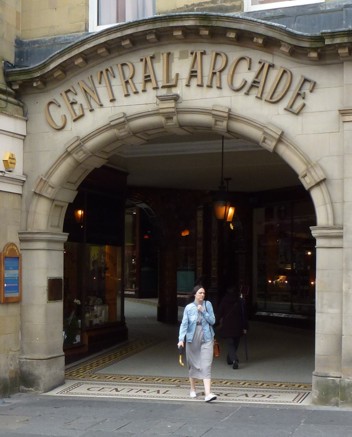
Central Arcade
I then checked out several sports and shoe shops in search of a pair of trainers but I found nothing that I wanted. All this traipsing about the shopping centre has made me tired, so I go to Di Marco’s café and order an Americano coffee with cold milk on the side, together with a Parma ham, mozarella and pesto panini.

Di Marco’s café
I sit at a table outside. The coffee is excellent and the panini is wonderful. I watch the ebb and flow of people and traffic moving up and down Grey street. Across the road a security guard nervously walks out of the bank clutching a small case which is, presumably, filled with cash. I suppose it could be his wife’s make-up bag but that might be overstretching the imagination somewhat. I have to be careful about doing that sort of thing or my author gives me a hard time. In fact I can feel that he is starting to close the pages of his notebook as I speak. By the time his pen is returned to his jacket breast pocket, I shall have temporarily ceased to exist. Speak to you later, my dear blogophiles.
 John's Quavering Pencil